Drug lookup
Drug reference

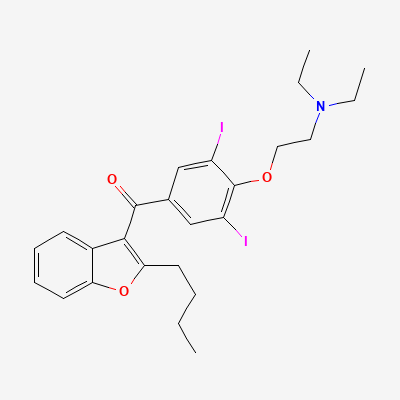
Amiodarone

Class III antiarrhythmic (multichannel) · Arrhythmia management

Also known as Amiodarone hydrochloride
START
Oral load 200 mg TID 1 wk → BID 1 wk → 200 mg/day; IV 150 mg/10 min then infusion; arrest 300 mg IV
TYPICAL MAX
~400 mg/day chronic maintenance; IV ≤2.2 g/24 h
STOP IF
Pulmonary toxicity, significant hepatotoxicity, severe brady/heart block, optic neuropathy
WATCH
Baseline + 6-monthly TFTs/LFTs, annual CXR/PFTs + eye exam, ECG/QT, drug interactions (CYP/P-gp)
CDSCO approvedSchedule HATC C01BD01
Dose laddermg/d
100start200titrate400max600ceiling
Renal dose adjustmenteGFR mL/min/1.73m²
FULLNo dose adjustment at any eGFR (hepatic/biliary clearance)90

KDIGO 2024 + manufacturer label

Pharmacokineticsplasma · t hours
4hONSET5hPEAK8.3w1dDURATION
ONSET
4h · oral absorption (effect over weeks)
PEAK
5h · Cmax
8.3w · terminal t½ (~58 days)
DURATION
1d · once-daily maintenance
EXCRETION
Hepatic CYP3A4; biliary/faecal, negligible renal
route + CYP
INTERACTIONS
12 major
incl. contraindicated
PREGNANCY
Avoid — fetal hypothyroidism/goitre, neurodevelopmental risk; only for life-threatening maternal arrhythmia
FDA category + note
Top interactionssee all 12
  • AmisulprideContraindicatedDatabaseDDInter
  • DomperidoneContraindicatedDatabaseKimi deep-research + Cla
  • SparfloxacinContraindicatedDatabaseDDInter
  • NirmatrelvirContraindicatedDatabaseKimi deep-research + Cla
Available in India

33 branded formulations. Look up specific brands in the Drugs workspace.

Mechanism

Prolongs action-potential duration/refractoriness via K+ channel blockade, with additional Na+ and Ca2+ channel and non-competitive alpha/beta blockade; broad antiarrhythmic activity. Iodine-rich, highly lipophilic, very long-acting.

Indications

Life-threatening recurrent ventricular arrhythmias (VT/VF)Atrial fibrillation/flutter (rhythm control, incl. structural heart disease)Pulseless VT/VF in cardiac arrest (ACLS)

Dosing

Adult
Oral load 200 mg TID ×1 week → 200 mg BID ×1 week → 200 mg/day maintenance (range 100–400 mg/day). IV: 150 mg over 10 min then 1 mg/min ×6 h then 0.5 mg/min; cardiac arrest 300 mg IV bolus.
Pediatric
5 mg/kg IV load (specialist).
Renal adjustment
No adjustment (hepatic/biliary clearance).
Hepatic adjustment
Monitor LFTs; reduce/withhold if significant hepatotoxicity.
Geriatric
Lower maintenance; heightened toxicity/thyroid risk.
Max dose
Maintenance usually ≤400 mg/day chronic; IV ≤2.2 g/24 h

Pharmacokinetics

Onset
IV minutes (some effects); oral days–weeks (loading needed)
Peak effect
Oral 3–7 h Cmax; full antiarrhythmic weeks
Duration
Weeks after discontinuation (huge tissue stores)
Half-life
~58 days (range 15–142 days)
Bioavailability
~35–65% (variable)
Protein binding
>96%
Metabolism
Hepatic CYP3A4/2C8 → active desethylamiodarone; strong CYP/P-gp inhibitor
Excretion
Biliary/faecal (negligible renal)

Contraindications

  • Severe sinus-node dysfunction / 2nd–3rd degree AV block without pacemaker
  • Marked sinus bradycardia/cardiogenic shock
  • Iodine hypersensitivity; thyroid dysfunction (relative)
  • Pregnancy (fetal thyroid/neuro harm)

Side effects

Common
Photosensitivity / slate-grey skin discolorationCorneal microdeposits (usually asymptomatic)GI upset, tremor, ataxiaThyroid dysfunction (hypo- or hyper-)Raised transaminases
Serious
  • Pulmonary toxicity/fibrosis (potentially fatal)
  • Hepatotoxicity (incl. fulminant)
  • Pro-arrhythmia/torsades; severe bradycardia/heart block
  • Amiodarone-induced thyrotoxicosis/hypothyroidism
  • Optic neuropathy/neuritis; peripheral neuropathy

Pregnancy & lactation

Pregnancy

Avoid — fetal hypothyroidism/goitre, neurodevelopmental risk; only for life-threatening maternal arrhythmia

Lactation

Contraindicated — significant excretion in milk, infant thyroid risk

Drug interactions

Amisulpride
Contraindicated
Database

Increased risk of Torsades de Pointes (TdP) and other ventricular arrhythmias

Concomitant use is contraindicated. Avoid combination.

Source: DDInter

Domperidone
Contraindicated
Database

Additive QT prolongation; high risk of torsades de pointes

Avoid combination; if unavoidable, monitor QTc closely

Source: Kimi deep-research + Cla

Sparfloxacin
Contraindicated
Database

Increased risk of Torsades de Pointes (TdP), ventricular arrhythmias, and sudden cardiac death.

Avoid concomitant use. If no alternative exists and co-administration is absolutely necessary, continuous ECG monitoring and electrolyte correction are mandatory, but generally not recommended.

Source: DDInter

Nirmatrelvir
Contraindicated
Database

Increased antiarrhythmic levels

Contraindicated; choose alternative COVID therapy

Source: Kimi deep-research + Cla

Abarelix
Severe
Database

Drug interaction classified as: synergy

Source: DDInter

Abiraterone
Severe
Database

Plasma levels of CYP2C8 substrates (e.g., amiodarone, carbamazepine, cerivastatin, diclofenac, ibuprofen, paclitaxel, rosiglitazone) may increase.

Requires careful monitoring for toxicity and possibly dose adjustment of the CYP2C8 substrate.

Source: DDInter

Acetazolamide
Severe
Database

Drug interaction classified as: synergy

Source: DDInter

Agalsidase Beta
Severe
Database

Drug interaction classified as: antagonism

Source: DDInter

Alfuzosin
Severe
Database

Drug interaction classified as: synergy.

Source: DDInter

Alimemazine
Severe
Database

Drug interaction classified as: synergy

Source: DDInter

Aminolevulinic Acid
Severe
Database

Drug interaction classified as: synergy

Source: DDInter

Amoxapine
Severe
Database

Drug interaction classified as: synergy

Source: DDInter

Related guidelines

Ask House about Amiodarone

Continue into a citation-backed clinical answer with the drug context already attached.

Sources: KD Tripathi 7e, Goodman & Gilman 14e, Harrison 22e, BNF·Verified: 2026-05-19 · House clinical team·Cockpit curated: 2026-05-19